
The short answer
An appointment setter calls every new remodeling lead, qualifies the homeowner by phone, and books a demo on your calendar with reminders, so your sales reps spend their time selling instead of dialing. Hire in-house when you have steady lead volume and a manager to coach setters. Outsource when you want coverage on day one and would rather pay per month than build a team.
What does an appointment setter do for a remodeling company?
An appointment setter turns a lead into a booked, qualified demo. That’s the whole job. They don’t sell the remodel, they don’t measure the bathroom, and they don’t quote. They get the right homeowner onto your calendar at a time your rep can make.
In practice, a setter for a bathroom remodeler does five things:
- Calls every new lead fast. The homeowner filled in a form a few minutes ago and is still thinking about their bathroom.
- Confirms the basics. Do they own the home, is it in your service area, and what project are they planning?
- Qualifies on budget and timeline. Is this a project for this season, at a range that fits your work?
- Books the demo. A specific time on your rep’s calendar, ideally with every decision-maker at the table.
- Sets up the show. Confirms by text, sends reminders, and re-books anyone who has to move.
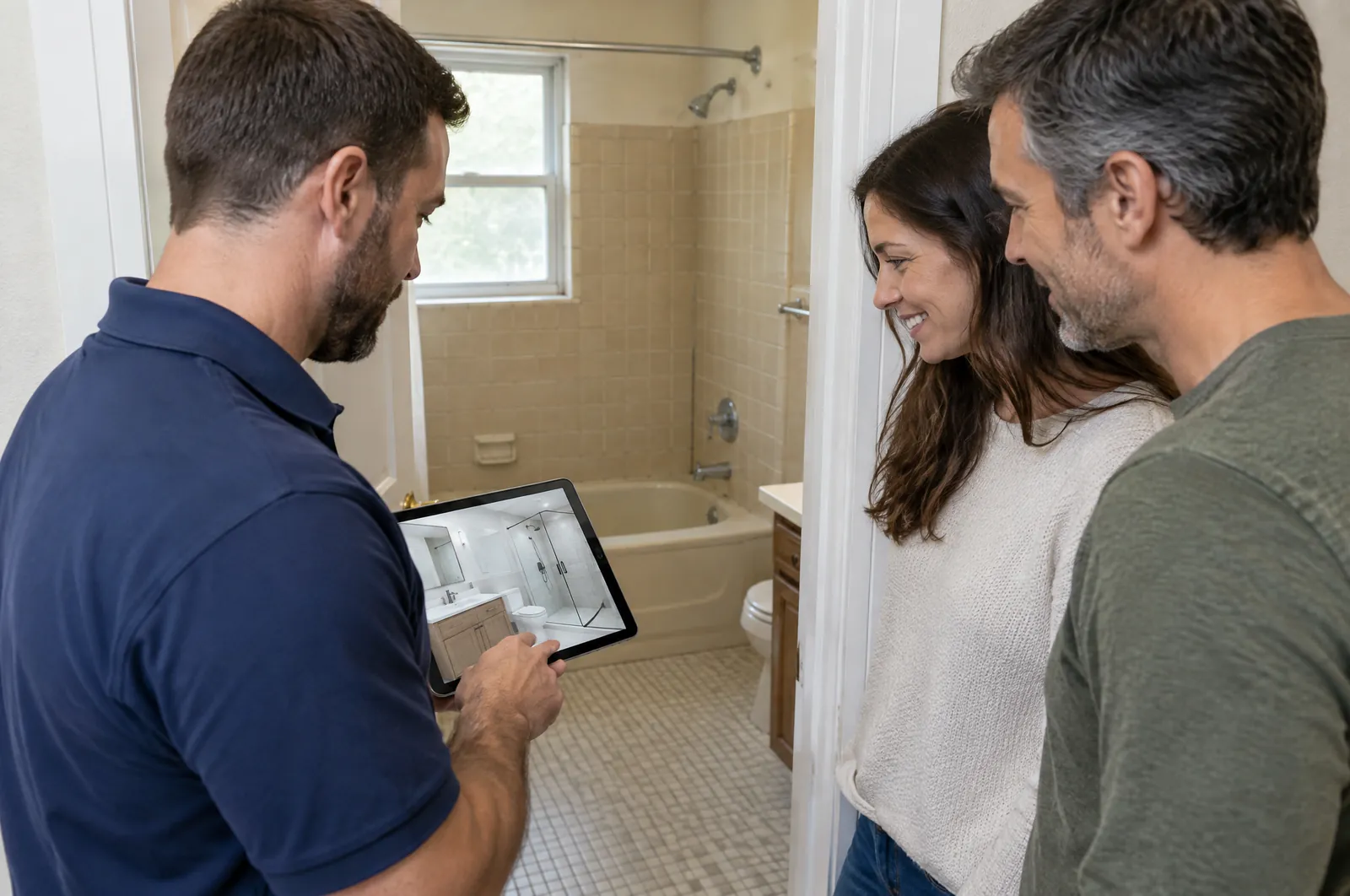
Your sales team still runs the in-home demo and closes the job. The setter just makes sure that when your rep gets in the truck, the appointment is worth the drive.
Why shouldn’t your sales reps set their own appointments?
Because calling leads and closing jobs compete for the same hours. A rep who spends the morning dialing new leads is a rep who isn’t prepping for the afternoon demo, and a rep who’s in a homeowner’s kitchen can’t answer a new lead that just came in.
The math gets worse as you grow. More leads means more dialing, which means less selling, right when you need more selling. Most remodeling companies doing $2M+ a year hit this wall: lead volume goes up and booked demos stay flat, because the people who should be closing are chasing.
Separating the two jobs fixes it. Setters live on the phone and get good at the first conversation. Reps live in the field and get good at the second one. It’s the same reason we argue in exclusive appointments vs. shared leads that a booked appointment, not a lead, is the thing worth paying for.
What does the call flow look like, from lead to booked demo?
A good call flow is short, consistent and written down, so every setter qualifies the same way and your reps know exactly what “booked” means.
| Step | What happens | Why it matters |
|---|---|---|
| 1. Lead comes in | Lead form answers (owner, budget, timeline) land in the CRM and alert the setter | The setter starts the call already knowing the project |
| 2. First call | Setter calls within minutes; a text goes out if there’s no answer | The homeowner is still at their phone and still interested |
| 3. Qualify | Confirm ownership, address, project, budget range and timeline | Screens out renters, wrong ZIPs and price shoppers |
| 4. Book | Pick a time on the rep’s calendar with all decision-makers present | A demo with one spouse missing often ends in “we’ll think about it” |
| 5. Confirm | Text confirmation with the rep’s name and what to expect | Turns a phone call into a commitment |
| 6. Remind | Reminders before the demo; re-book anyone who can’t make it | Protects your rep’s day from no-shows |
Steps 2 and 6 are where most companies leak. We go deeper on the first in speed to lead for remodelers and the second in how to cut no-shows on in-home appointments.
Should you hire setters in-house or outsource appointment setting?
Hire in-house if you have steady lead volume, someone to manage and coach setters, and the patience to build the role. Outsource if you need coverage now, your lead volume swings with the seasons, or you don’t want to manage another team.
| In-house setters | Outsourced setting team | |
|---|---|---|
| Speed to start | Weeks: hire, train, write scripts | Days, if the team already sets for remodelers |
| Coverage | Limited to their shifts, sick days and vacations | Usually wider hours and backup callers |
| Product knowledge | Deep, and it grows over time | Depends on how well they’re briefed on your offer |
| Management | You coach, schedule and replace them | The provider does; you review results |
| Cost shape | Salary, commission, phone system, turnover | A monthly fee |
| Biggest risk | One good setter leaves and bookings drop | A generic script that doesn’t sound like your company |
Plenty of companies end up with a mix: an outsourced team for speed and coverage, plus an AI agent for the very first touch after hours. We cover where automation fits, and where it doesn’t, in AI follow-up for remodeling leads.
How do you brief setters so they sound like your company?
Give setters the same information your best salesperson would want before a demo: what you sell, who you sell it to, and what makes your company different. A setter who can only read a script sounds like a call center. A setter who understands your offer sounds like your office.
A one-page setter brief should cover:
- The offer. The project, the starting price, what’s included, your warranty, and the real reason to book now.
- The service area. The ZIP codes you take, and what to say to someone just outside them.
- The projects you want. If full primary-bath remodels are your best work, setters should know to prioritize them.
- The qualifying bar. What has to be true for a booking to count. We define that in what counts as a qualified bathroom remodeling appointment.
- Common questions. How long a remodel takes, whether you finance, what the in-home visit involves, and who will come.
- The calendar rules. How long a demo runs, drive-time buffers, and which reps cover which areas.
Then close the loop. After each demo, your rep should leave a short lead-quality note, and setters should read them. That feedback is how the qualifying gets sharper every week instead of drifting.
What does appointment setting cost?
Estimated 2026 US market rates for outsourced appointment setting run about $2,000 to $8,000 a month. That’s an estimate of comparable standalone services, not a quote, and the range is wide because providers differ on hours, call volume and how much qualifying they do.
When you compare providers, ask:
- How fast do they call a new lead, and what happens after hours?
- What exactly counts as a qualified, booked appointment?
- Do they confirm and remind, or just book?
- Will you see every call outcome, or only a monthly summary?
- Have they set appointments for remodelers before, or is this their first home-improvement account?
The real comparison isn’t the monthly fee. It’s your cost per booked, qualified demo before and after. Our line-by-line market rates for remodeling marketing show how setting fits into the rest of the stack.
How do you know your setters are working?
Track every lead from the first click to the closed job, and judge setters on booked and showed appointments, not on dials. Activity numbers are easy to inflate. Demos that show up and sit down aren’t.
- Booked rate: the share of leads that become a booked appointment.
- Show rate: the share of booked appointments where the homeowner is actually home and ready.
- Close rate: the share of demos your reps sell. If this drops while booked rate rises, the setters may be loosening the qualifying.
- Lead quality notes: your reps’ feedback after each demo, fed back to the setters and the ads.
Read those rates together. High booked and low show points to weak confirmations. High show and low close points to the offer or the sales process. The full list is in remodeling marketing KPIs.
How YardScale handles setting
At YardScale, our team calls every lead from your ads, qualifies them by phone, and books the demo on your calendar with reminders. Every lead and appointment posts live in your private Slack channel, and our CRM tracks booked, showed and closed rates so you can see exactly where each lead stands.
Whether you build a team or hire one, the principle is the same: your sales team should spend its time on qualified demos, not on chasing leads. If you want to see how the whole system fits together, here’s how it works.
Key takeaways
- A setter’s job is a booked, qualified demo on your calendar, not a sale.
- Calling leads and closing jobs compete for the same hours, so split the roles.
- In-house setters build deep knowledge; outsourced teams give coverage on day one.
- Estimated 2026 market rates for outsourced setting run about $2,000–$8,000 a month (not a quote).
- Judge setters on booked, showed and closed rates, not on how many calls they make.